
Our Articles


Blog

Published on June 27, 2026
A chest freezer and an upright freezer fail for different reasons. Chest freezers most commonly develop lid gasket leaks, thermostat failure, start relay problems, and manual defrost buildup. Upright freezers fail more often from evaporator fan failure, blocked vents, door gasket leaks, and auto-defrost system faults. Both types face added stress from Sacramento's summer heat, especially in garage placements.
TL;DR
● The freezer type determines the diagnosis. Chest freezer problems usually start with the lid seal or thermostat. Upright freezer problems usually start with airflow, the fan, or the defrost system.
● If your freezer is running but not holding 0°F, don't wait. Food becomes unsafe above 40°F, and a full freezer loses its temperature within 48 hours with the door closed.
● Call Fair Appliance Repair at (916) 333-8388 for same-day freezer repair in Sacramento.
The design of each freezer determines where it fails. Understanding that design makes the diagnosis faster.
A chest freezer opens from the top. Cold air is denser than warm air, so when you lift the lid, most of the cold stays inside. This gives chest freezers a natural efficiency advantage, but it also means the lid gasket does a lot of work. If that seal weakens, warm moist air gets in every time you open the unit. Chest freezers also require manual defrosting, which means frost builds up over time until you remove it by hand.
An upright freezer opens from the front, like a refrigerator. Cold air spills out every time the door opens, so the unit has to work harder to recover. To compensate, most uprights use an evaporator fan to circulate cold air through vents and shelves. They also run an automatic defrost cycle, which involves a defrost heater, a timer or control board, a thermostat, and a drain. That's four additional components that can fail. When any one of them stops working, the whole defrost cycle fails and frost blocks the evaporator coil.
The practical difference: chest freezers have fewer components, so there are fewer things to diagnose. Upright freezers are more convenient to organize, but repairs are more involved because multiple systems work together. A technician servicing a chest freezer usually checks five components or fewer. An upright can involve twice that many.
Sacramento homeowners who store bulk groceries or use a garage freezer for overflow storage often have both types. The sections below cover the most common failure points for each.
A chest freezer that isn't holding 0°F has one of four problems: a failed thermostat, a weak start relay, dirty condenser coils, or a compressor that's struggling to start. Check the thermostat setting first. If it's correct and the unit is running but not cold, listen for the compressor. A short hum followed by a click every few minutes means the compressor is trying to start but failing, which points to the start relay or the compressor itself. If the unit is silent, the issue is likely electrical. If it runs continuously but stays warm, coils or refrigerants are the next check.
A weak lid gasket is the most common chest freezer problem in Sacramento homes, and it's easy to miss because the lid still closes. Warm, moist air enters even through a small gap in the seal, then freezes inside the cabinet. Signs include frost forming around the lid edges, food near the top thawing or getting soft, and the compressor running longer than usual. To test the gasket, close the lid on a piece of paper and pull it out. If it slides out without resistance, the seal isn't holding. Clean the gasket first with warm water and a soft cloth. If it's cracked, flattened, or warped, it needs replacing. Also check whether the lid itself is warped or whether storage baskets are preventing full closure.
Thick frost inside a chest freezer is almost always caused by one of two things: a failing lid gasket or a manual defrost that's overdue. A single inch of frost across the interior walls can drop the effective temperature and force the compressor to run harder. Two inches or more is a real problem. If frost returns within two to four weeks of a full defrost, the gasket is the culprit, not the frequency of defrosting. Inspect the lid seal, check how often the freezer is opened, and look at whether it's placed in high-humidity conditions like an unventilated garage.
A clicking noise from a chest freezer is almost always the compressor attempting to start and failing. This usually means the start relay has failed, the overload protector has tripped, or the compressor itself is at the end of its life. A short hum before the click is the clearest tell. A continuous hum with no click is a different issue, often a fan motor or a compressor running but not pumping properly. Don't let a clicking compressor run for more than a day without diagnosis. Each failed start attempt generates heat inside the compressor, and repeated overheating shortens the remaining lifespan fast.
Sacramento typically records 10 to 30 days above 100°F per year, with some years hitting even higher according to historical NOAA weather records. An unventilated garage can hit 120°F or higher during a heat wave. Most residential chest freezers are rated to operate in ambient temperatures up to 110°F. When the garage exceeds that, the compressor can't reject heat fast enough, and the freezer loses its ability to hold temperature. This isn't a repair problem, strictly speaking, but it creates one: a unit that runs constantly in extreme heat wears out its compressor faster, and borderline components fail under the added load. If your garage freezer stops cooling in July or August, check airflow around the unit first. Six inches of clearance on all sides is the minimum. Clean the condenser coils of dust and debris. If the unit is more than ten years old and failing in summer heat, the compressor may not survive another Sacramento summer.
An upright freezer that runs but won't hold temperature is usually an airflow problem before it's a compressor problem. Check whether packages are pressed against the back wall or covering the vents inside the cabinet. Blocked vents starve the evaporator coil of airflow and the freezer warms up even with a working compressor. If the vents are clear, the next check is the evaporator fan. Open the freezer door, press the door switch manually, and listen for the fan. No fan noise means no airflow, and that alone will keep the freezer warm. If the fan is running and the vents are clear, the defrost system and compressor are the next suspects.
An upright freezer that frosts up heavily has either a door gasket leak or a failed auto-defrost system. The two causes produce the same symptom, so the distinction matters for the repair. If frost is heaviest near the door or on the front walls, suspect the gasket. If frost is thick on the back panel around the evaporator coil and the freezer is still cold but airflow feels weak, the defrost system isn't running. That means the defrost heater, defrost thermostat, timer, or control board has failed. A technician needs to test each component to find which one stopped the cycle. Manually defrosting the unit will fix the symptom temporarily, but the frost returns within one to three weeks if the underlying fault isn't repaired.
The evaporator fan is what makes an upright freezer different from a chest freezer. Without it, cold air doesn't circulate, and the freezer develops warm and cold spots instead of a consistent temperature. A failed evaporator fan motor is one of the most common upright freezer repairs. Signs include uneven temperatures across shelves, frost building up near the fan cover while the rest of the freezer stays too warm, and a faint grinding or scraping sound when the unit is running. Scraping usually means ice has built up around the fan blade, which is a defrost system problem causing the fan symptom. Grinding means the motor bearing is failing. Either way, a technician should test the motor, the wiring, and the signal from the control board before replacing parts.
A leaking door gasket on an upright freezer causes the same problem as a lid gasket leak on a chest freezer, but it's easier to overlook because the door still closes and latches. Test it the same way: close the door on a dollar bill and pull. No resistance means the seal is weak. On an upright freezer, a bad gasket can also be caused by hinge misalignment or a cabinet that isn't level. If the freezer tilts forward, the door doesn't sit flush against the frame and the gasket never seals fully. Check level before replacing the gasket. Sometimes adjusting the feet solves the problem without any parts.
Water on the floor near an upright freezer usually comes from a clogged defrost drain. During each defrost cycle, meltwater runs down a channel to a drain at the bottom of the freezer compartment, then into an evaporation pan under the unit. If ice or debris blocks that drain, water backs up and freezes at the bottom of the compartment, then eventually overflows onto the floor. Clearing a clogged defrost drain is a straightforward repair: a technician melts the ice blockage, clears the debris, and checks that the drain channel slopes correctly. On models with an ice maker, water can also come from the inlet valve or the water supply line, which is a separate issue.
Temperature swings in an upright freezer come from one of four sources: a failing temperature sensor, a weak door gasket, blocked airflow inside the cabinet, or a defrost cycle that runs too long. The sensor is the most common electronic cause. When it reads incorrectly, the control board doesn't know when to start or stop the compressor. Use a standalone appliance thermometer placed between frozen items for 30 minutes rather than relying on the built-in display. The display reads the air temperature, which changes every time you open the door. The thermometer reads the actual cold mass temperature, which is what matters for food safety. If the thermometer reads above 10°F consistently, call a technician regardless of what the display shows.
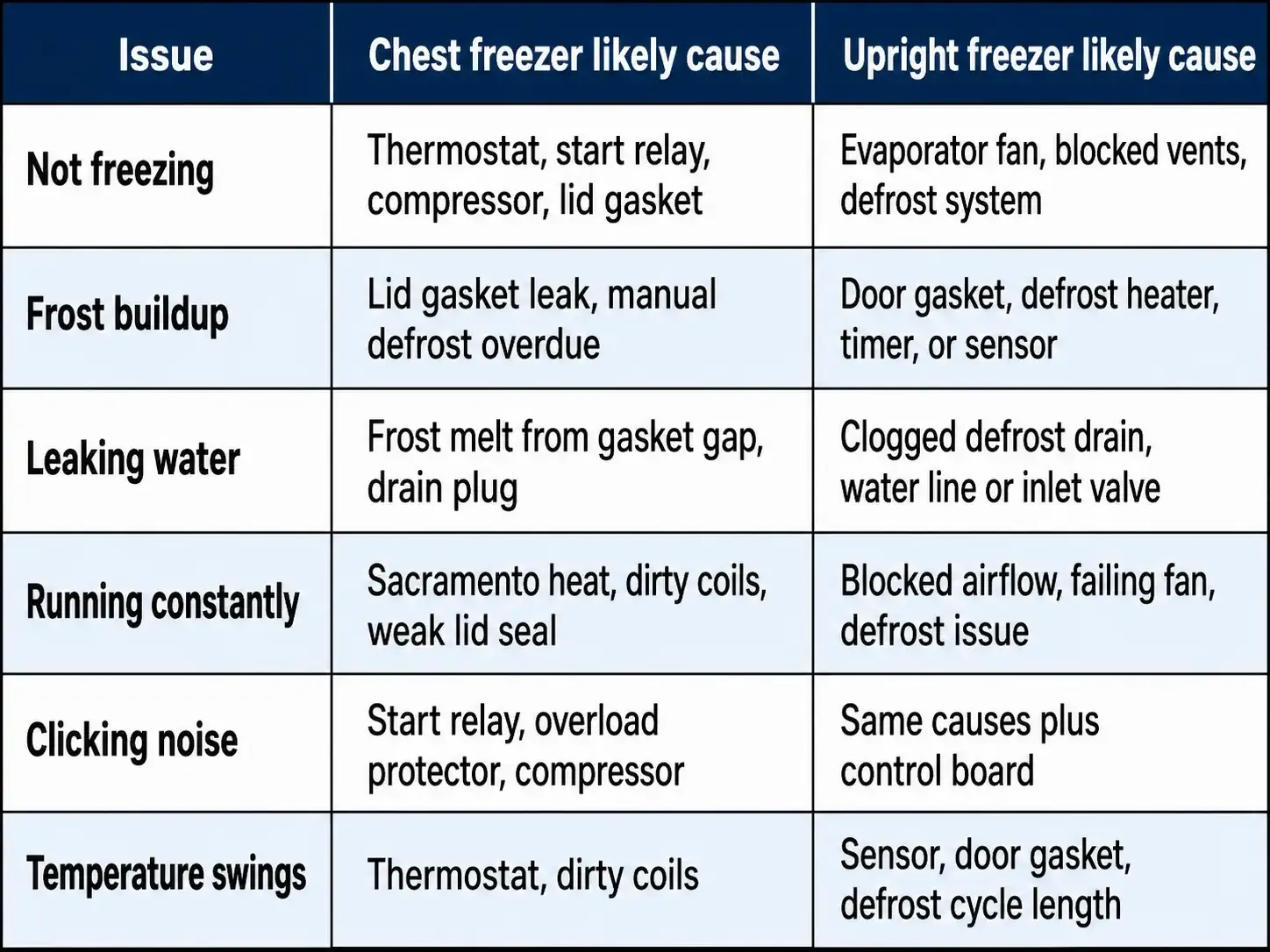
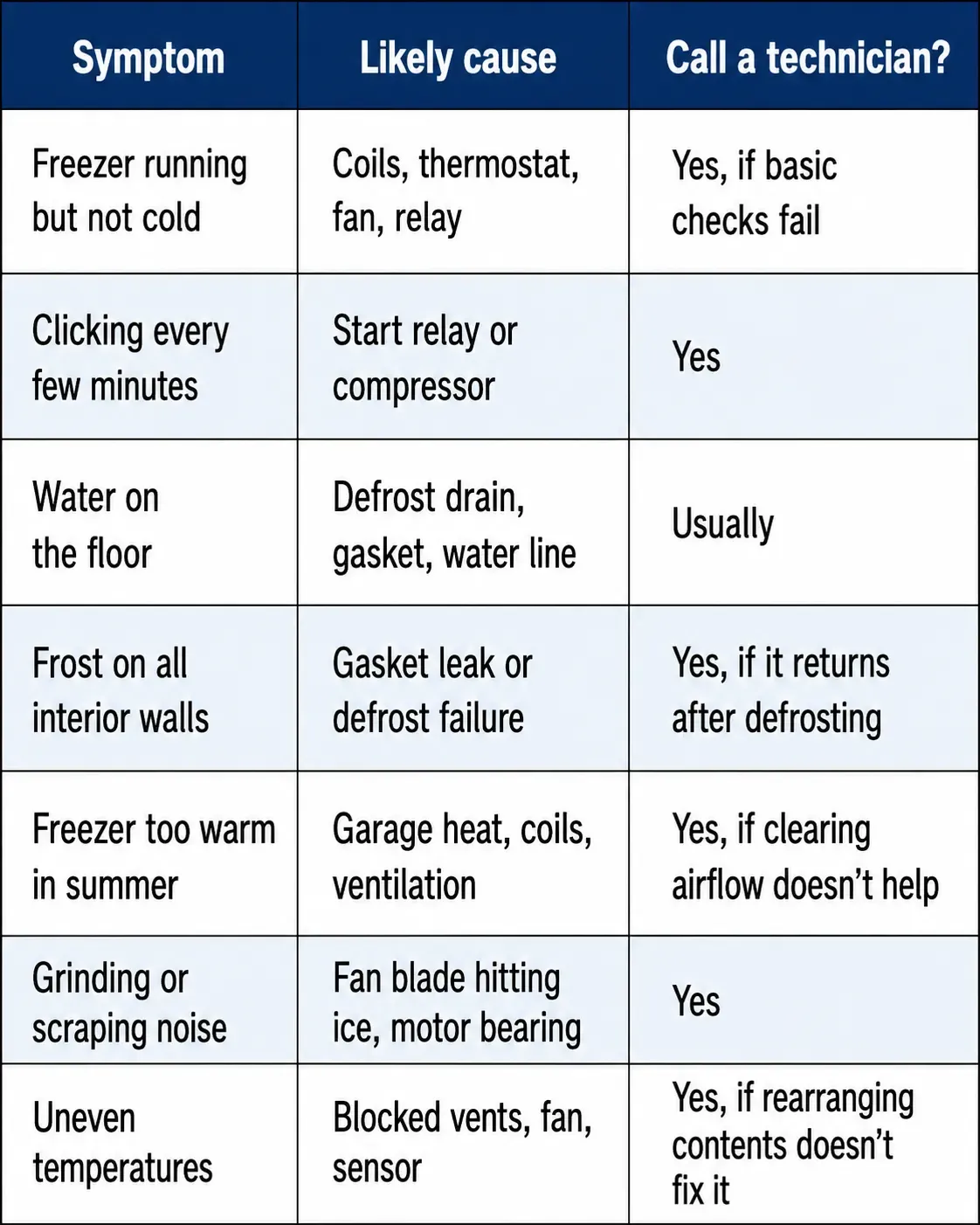
The tables below are a fast reference for matching symptoms to likely causes by freezer type.
Freezer type vs. common failure points
Symptom-to-action guide
Which freezer is easier to repair? Chest freezers are simpler because fewer components are involved: the lid gasket, thermostat, start relay, and compressor cover most repairs. Upright freezer repairs are more involved because the fan, defrost system, sensor, and control board interact with each other and any one of them can produce overlapping symptoms.
Before you call, run through these checks. Several common freezer complaints resolve without a service visit, and ruling them out first saves you time and a diagnostic fee.
● Power and settings. Confirm the freezer is plugged in, the outlet is live, and the breaker hasn't tripped. Check that the temperature dial or digital setting hasn't been changed accidentally. Some models have a demo or showroom mode that disables cooling entirely.
● Door or lid closure. Open and reclose the door or lid firmly. Check whether packaging, a basket, or an ice buildup is preventing full closure. Even a small gap is enough to raise the internal temperature several degrees over a few hours.
● Gasket condition. Run your fingers around the full perimeter of the gasket. Feel for tears, soft spots, or sections that have flattened against the frame and no longer spring back. Do the dollar-bill test described earlier.
● Vent clearance. On an upright freezer, make sure no items are pressed directly against the rear vents or stacked so tightly that air can't circulate between shelves. Rearrange contents and wait two hours to see if the temperature recovers.
● Coil area and cabinet clearance. Pull the freezer away from the wall and check for visible dust buildup around the condenser area. On chest freezers, the coils are often on the exterior sides or bottom. Six inches of clearance on all sides is the minimum for proper heat rejection.
Noise. Listen for clicking, grinding, or a compressor that runs for short bursts and stops. Note exactly what you hear and when. That information helps a technician diagnose faster and reduces the time they spend on-site.
If the freezer is still warm after all of these checks, or if you hear clicking, smell anything burning, or notice the compressor is unusually hot to the touch, stop troubleshooting and call. Those symptoms need a technician, not more DIY investigation.
This is one of the more common upright freezer calls Fair Appliance Repair handles during Sacramento summers.
A homeowner in North Sacramento called in July with an upright Whirlpool freezer that had been "running constantly" for about two weeks. Food near the top shelf was soft. The bottom shelf was still frozen solid. She assumed the compressor was failing and was ready to replace the unit.
The technician arrived and checked the obvious first. Vents were clear. The door gasket was intact. The compressor was running and the unit was drawing normal amperage. But when the technician removed the rear interior panel, the evaporator coil was buried under two inches of frost. The defrost heater had burned out, so the automatic defrost cycle hadn't run in weeks. Frost had completely blocked airflow to the upper shelf while the lower portion stayed cold from residual compressor output.
The repair: a new defrost heater, a manual defrost of the coil, and a check of the defrost timer and drain. Total time on-site was about 90 minutes. The freezer was back at 0°F within four hours.
The homeowner would have replaced a working compressor. The actual failed part cost a fraction of a new unit.
This case comes up repeatedly in Sacramento summers because the heat puts extra demand on the defrost system. A freezer cycling more aggressively to fight ambient heat generates more frost per cycle. When the defrost heater is already marginal, that's enough to push it over the edge. If your upright freezer has uneven temperatures, with some shelves warm and others cold, defrost system failure is the first thing a technician should check before anything else.
The 50% rule is the standard starting point: if the repair cost approaches half the price of a comparable new freezer, replacement is worth serious consideration. In practice, most freezer repairs in Sacramento fall well below that threshold.
Typical repair costs run $150 to $400 for most common failures. A start relay replacement is usually under $100 in parts and takes less than 30 minutes. A lid or door gasket replacement runs $100 to $200 depending on the model. An evaporator fan motor, defrost heater, or thermostat replacement typically lands in the $150 to $300 range including labor. These repairs are almost always worth doing on a unit that's less than ten years old.
The calculation changes for two types of repairs: compressor replacement and sealed system work. A compressor replacement on a residential freezer can run $300 to $600 or more, sometimes approaching the cost of a new mid-range unit. Sealed system repairs, which involve refrigerant handling, are similarly expensive. For those repairs, age matters a lot. A five-year-old freezer with a failed compressor is usually worth repairing. A twelve-year-old unit with the same problem on a hot Sacramento summer day is closer to a coin flip.
A few other signals that point toward replacement regardless of repair cost: visible rust on the cabinet or interior walls, a model where replacement parts are no longer manufactured, repeated breakdowns on different components within the same year, or a chest freezer that's been running in a 120-degree garage for a decade without service.
When a technician at Fair Appliance Repair diagnoses a freezer, they give you the repair cost before any work starts. If replacement makes more financial sense, they'll tell you that directly.
The rule is simple: judge food by temperature, not appearance or smell. A full freezer that stays closed holds 0°F for roughly 48 hours after power loss or failure. A half-full freezer holds temperature for about 24 hours. After that, the temperature rises and the risk of spoilage increases fast.
The U.S. Food and Drug Administration sets 40°F as the threshold. Any frozen food that has reached 40°F or above for more than two hours is in the danger zone for bacterial growth. Food that still has ice crystals throughout, or that has stayed at 40°F or below, is generally safe to refreeze or cook. Food that has fully thawed and reached room temperature should not be refrozen.
A few practical steps if your freezer stops working:
Keep the door closed. Every opening releases cold air and shortens the window. You have to get the unit repaired or the food moved. Place an appliance thermometer inside before closing the door so you can read the temperature without opening it again.
Don't judge by look or feel. Meat that still feels cold to the touch may have already crossed the 40°F threshold. A thermometer is the only reliable check.
Move high-value items first. If you need to open the freezer, prioritize meat, seafood, and breast milk. These spoil fastest and are the most expensive to replace.
Call quickly. Fair Appliance Repair offers emergency freezer repair in Sacramento at (916) 333-8388. The faster a diagnosis happens, the more likely the food is recoverable. A repair that takes 90 minutes on-site is worth a phone call before you start throwing food away.
When your chest freezer or upright freezer stops working, the clock starts on your food. Fair Appliance Repair handles freezer diagnosis and repair across Sacramento, including chest freezers, upright freezers, garage-placement units, refrigerator-freezer combos, and commercial equipment.
Fair Appliance Repair
341 Rick Heinrich Cir, Sacramento, CA 95835
(916) 333-8388
Find us on Google Maps : https://www.google.com/maps?cid=7027228233403408814
Q1: Are chest freezers easier to repair than upright freezers?
Usually yes. Chest freezers have fewer components, so diagnosis is faster. The most common repairs involve the lid gasket, thermostat, start relay, or compressor. Upright freezers have more systems working together, including the evaporator fan, defrost heater, sensor, and control board, so repairs typically take more diagnostic time.
Q2: Why is my upright freezer frosting up but still cold?
Heavy frost with normal temperatures almost always means the auto-defrost system has stopped running. The defrost heater, timer, or thermostat has failed, so frost accumulates on the evaporator coil instead of melting away between cycles. Manually defrosting will fix it temporarily, but the frost returns in one to three weeks unless the faulty component is replaced.
Q3: Why is my freezer not cooling in Sacramento summer heat?
Garage placements are the most common cause during summer. Sacramento regularly hits 100°F or above, and an unventilated garage can reach 120°F. Most residential freezers are only rated for ambient temperatures up to 110°F. Above that, the compressor can't reject heat fast enough. Start by checking clearance around the unit and cleaning the condenser coils. If the problem continues, call a technician.
Q4: Is it worth repairing a freezer or should I just replace it?
For most repairs, yes. Typical freezer repairs in Sacramento cost $150 to $400. Gasket replacements, fan motors, defrost heaters, and start relays are almost always worth repairing on a unit under ten years old. Compressor replacement on an older unit is where the math gets closer. A technician will give you the cost before starting work so you can make an informed decision.
Q5: What does a clicking noise from my freezer mean?
A click every few minutes, often preceded by a short hum, means the compressor is trying to start and failing. The most common causes are a failed start relay or a tripped overload protector. Left unaddressed, each failed start attempt generates heat inside the compressor and accelerates damage. Call a technician rather than letting it run.
Q6: How long can I leave my freezer off before food spoils?
A full freezer with the door closed holds 0°F for about 48 hours. A half-full freezer holds a safe temperature for roughly 24 hours. Once food reaches 40°F and stays there for more than two hours, it enters the bacterial danger zone. Use an appliance thermometer to check before opening the unit.
Q7: Can Fair Appliance Repair fix a garage freezer in Sacramento?
Yes. Garage freezer calls are common, especially during summer. The technician will check clearance, coil condition, compressor health, and whether the unit is rated for the ambient temperatures your garage reaches. Some older units simply aren't built for Sacramento garage conditions, and a technician will tell you that honestly.
Q8: Why is there water leaking from my upright freezer?
The most common cause is a clogged defrost drain. Meltwater from the defrost cycle backs up, freezes at the bottom of the compartment, and eventually overflows onto the floor. Clearing the drain is usually a straightforward repair. On models with an ice maker, the water line or inlet valve may also be the source.
Q9: How long does a freezer repair take?
Most repairs are completed in one visit of 60 to 90 minutes. Repairs that require an ordered part, such as a specific compressor or a hard-to-source control board, may require a second visit. Fair Appliance Repair carries common replacement parts on the truck to handle most repairs same-day.
Q10: What freezer brands does Fair Appliance Repair service?
Fair Appliance Repair services all major brands, including Whirlpool, GE, LG, Samsung, Frigidaire, Kenmore, Maytag, Amana, and others. If you're unsure whether your brand is covered, call (916) 333-8388 and confirm before booking.


