
Our Articles


Blog

Published on July 5, 2026
A dryer taking too long to dry is almost always an airflow problem, not a heat problem. In most of the slow dryers we open up across Sacramento, a lint-clogged vent is restricting airflow, so hot damp air stays trapped in the drum and clothes come out warm but wet. Most fixes take under an hour.
TL;DR
● A normal load should dry in one cycle of about 35 to 45 minutes. Consistently longer means restricted airflow, and the vent is the first place to check.
● Work through the 9 fixes below in order: vent, lint screen, load size, duct, washer, moisture sensor, then the heating system.
●Vent buried in a wall, no heat at all, or a burning smell? Call Fair Appliance Repair Service at (916) 333-8388 for same-day dryer repair in Sacramento. Diagnosis is free with any repair.
You started the cycle an hour ago. The hoodie is still damp, so you hit start again and hope. If that has become your laundry routine, this guide is for you. I'm Sayed Sajadi, lead technician at Fair Appliance Repair Service (California License #48671, EPA Certified), and after 4,000+ appliance repairs in Sacramento homes, I can tell you exactly where to look first, what you can fix yourself, and what a pro visit actually costs.
A healthy dryer dries a normal mixed load in 35 to 45 minutes on medium to high heat. Towels and jeans can take 50 to 60 minutes. If your dryer regularly needs more than an hour, or takes two cycles to dry, something is restricting heat or airflow.
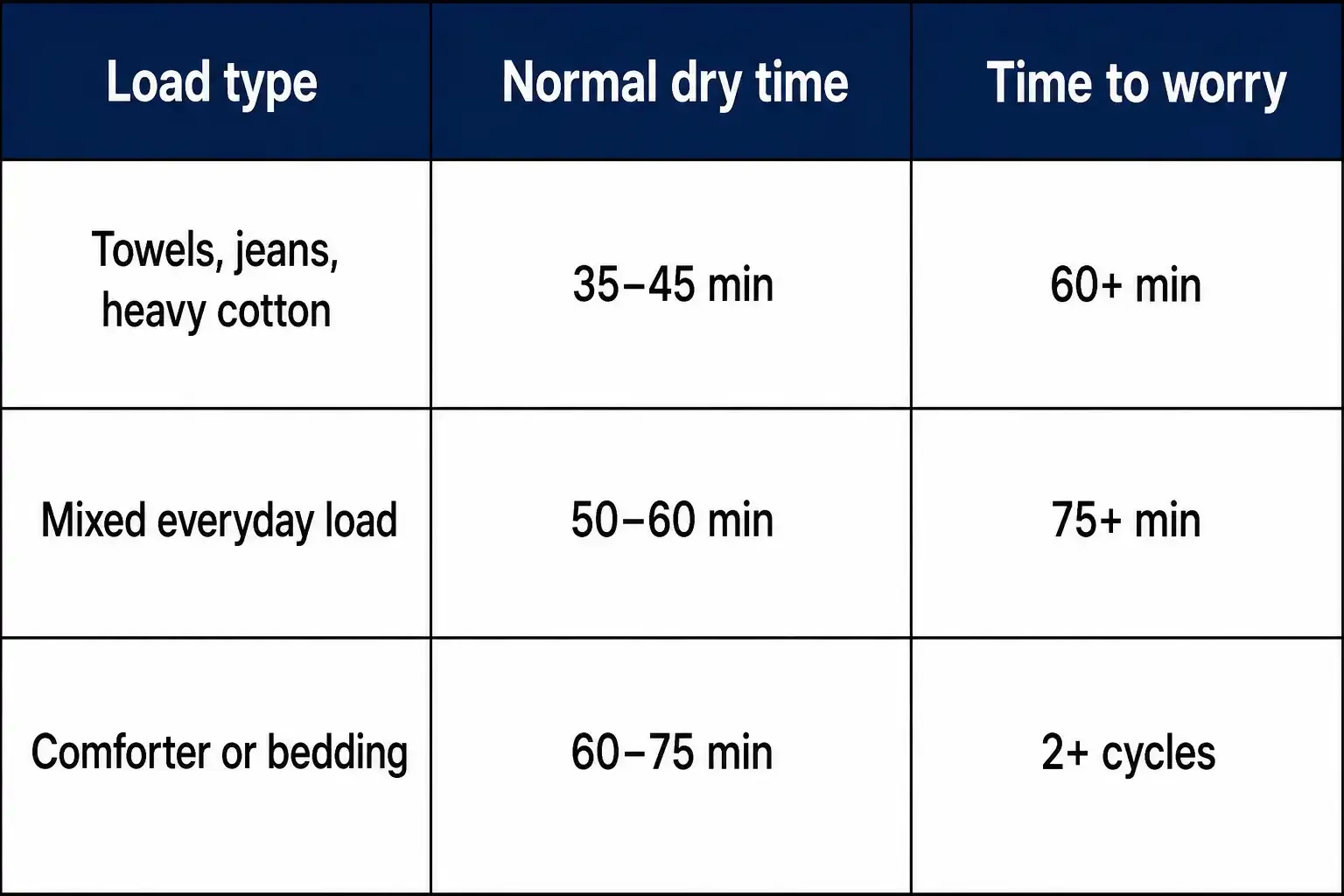
One slow load after a heavy wash day is normal. A pattern of slow loads is a symptom, and to understand it you need to know how a dryer actually works.
A dryer does not bake your clothes dry. It moves moisture out. The heating element (or gas burner) warms the air, and a blower pushes that hot air through the tumbling clothes and out the exhaust vent, carrying the moisture with it. Cut off the exhaust path and the wet air has nowhere to go. It just circulates in the drum, which is why a dryer with restricted airflow runs hot yet still hands you damp laundry.
That is the key diagnostic idea behind every fix in this guide: if the dryer makes heat but drying takes forever, you are hunting an airflow problem first.
A clogged dryer vent is the most common reason a dryer takes too long to dry. Every load sheds lint, the lint screen only catches part of it, and the rest slowly coats the inside of the vent duct. Sacramento makes this worse. Our dusty, dry climate clogs vents faster than most regions, and we regularly find vents fully blocked within six months in busy households. Older Midtown and East Sacramento homes with long duct runs, and two-story houses that vent through the roof, are the worst offenders.
● Clothes need two or more cycles to dry
●Laundry comes out hot but still damp
●The top or sides of the dryer feel hot to the touch
●A burning or musty smell while it runs
● The laundry room feels humid or steamy
●Weak airflow at the outside vent flap while the dryer runs
● Lint collecting around the exterior vent hood
Two or more of these means the vent needs cleaning before you spend a dollar on parts.
If your duct disappears into a wall cavity or runs up through the roof, a hardware-store brush kit usually cannot reach the whole run, and pushing lint deeper creates a bigger blockage. Restricted vents are also a fire risk: the U.S. Department of Energy advises inspecting your dryer vent regularly because a blocked vent wastes energy and "may prevent a fire" when kept clear (energy.gov laundry guidance). Long or vertical runs are a job for a technician with the right rods and vacuum, and we handle them across Sacramento, Natomas, and Elk Grove every week.
For a short, straight vent run, DIY cleaning works fine. You'll need a screwdriver, a vacuum with a hose attachment, a vent brush, and a flashlight.
1: Unplug the dryer (shut the gas valve too, if it's a gas model).
2: Pull the dryer away from the wall.
3: Loosen the clamp and detach the vent hose.
4: Vacuum lint out of both ends of the hose.
5: Run the vent brush through the full length of the hose.
6: Vacuum the vent opening on the back of the dryer.
7: Go outside and clean the exterior vent hood and flap.
8: Reattach the hose and tighten the clamp.
9: Push the dryer back without crushing the hose.
10: Run a short heated cycle and confirm strong airflow outside.
My tip from Sacramento service calls: while you're outside, hold your hand near the vent flap during the test cycle. You should feel a steady push of warm air. Weak flow means lint is still hiding somewhere in the run, and that leads straight into the next set of airflow killers.
A lint screen can look clean and still choke airflow. Dryer sheets and fabric softener leave an invisible waxy film on the mesh. Pull the screen and run water over it: if water pools instead of draining through, wash the screen with warm water, dish soap, and a soft brush, then dry it fully. Do this monthly. The Department of Energy also recommends vacuuming the lint slot below the screen, where lint collects out of sight.
Clothes dry by tumbling through hot air. Pack the drum full and the middle of the load never sees that air, so it stays wet while the outer layer dries. Keep the drum about two-thirds full. Big comforter? Dry it alone.
Every time a dryer gets shoved back against the wall, that flexible duct behind it can kink or flatten, and a crushed duct chokes airflow just like a clog. Pull the dryer out and check for pinch points. And if the duct is thin plastic or foil, replace it: manufacturers recommend rigid venting material because collapsible plastic ducts sag, trap lint, and cause blockages, per the same energy.gov guidance. In California, rigid or semi-rigid metal duct is the standard we install on every job.
Sometimes the dryer is innocent. If your washer's spin cycle is weak, clothes go in soaked and no dryer can finish them in 45 minutes. If laundry feels dripping wet out of the washer, that is the machine to look at. Our washing machine repair team in Sacramento sees failing spin cycles masquerade as "dryer problems" all the time.
Auto-dry cycles rely on two small metal strips inside the drum, usually near the lint screen. Coat them with softener residue and they misread your clothes as dry (cycle ends early) or wet (cycle runs forever). Wipe the strips with rubbing alcohol on a cloth. This one is especially common on the Samsung and LG dryers we service around Sacramento.
Here is the fork in the road. Run the dryer five minutes on high, then check the air at the outside vent.
Hot air, weak flow? It's airflow. Go back to Fixes 1 to 5.
Strong flow, cool air? The heating system is failing. On electric dryers that means the heating element, thermal fuse, or cycling thermostat (Fix 8). On gas dryers, the igniter or gas valve solenoid (Fix 9). A worn igniter will glow but never open the gas valve, which is a classic on the Whirlpool and Maytag gas dryers we repair. These parts need multimeter testing and safe disassembly, so this is where DIY should stop, especially on gas. Our vans carry heating elements, thermal fuses, thermostats, and igniters for all major brands, which is why we finish most Sacramento dryer repairs in one visit.
Running two cycles per load doubles the energy every load uses, adds heat wear that fades and thins your clothes, and ages the motor and bearings twice as fast. It also keeps hot air sitting on lint longer, which is exactly the condition fire-safety guidance warns about. A slow dryer is not a quirk to live with. It is the most expensive way to do laundry.
Call a technician when the vent runs through a wall or roof, the dryer makes no heat, the breaker trips, or you smell burning. Here is honest Sacramento pricing from our own job history at Fair Appliance Repair Service: most dryer repairs run $150 to $350. A heating element part is typically $30 to $100 plus labor, and a control board runs $150 to $300. The diagnostic is free when you go ahead with the repair, you get a written quote before any work starts, and every repair carries a 90-day labor guarantee with parts covered 90 to 365 days. With 700+ five-star Google reviews, same-day appointments, and one licensed technician handling every job, you know exactly who is showing up. If your dryer is also making thumping or squealing noises, that points to a different set of parts, and our same-day dryer repair service in Sacramento covers both.
● Clear the lint screen before every load
● Wash the screen with soap and water monthly
● Fill the drum no more than two-thirds
● Match the cycle to the load (no delicate setting for towels)
● Glance at the outside vent flap monthly
● Get the vent professionally cleaned yearly, every six months for heavy use in dusty Sacramento neighborhoods
You've cleaned the screen and checked the duct. If your dryer is still slow, the problem is in the vent run or the heating system, and that is a 20-minute diagnosis for us. Book same-day dryer repair anywhere in Sacramento, Elk Grove, Roseville, or Davis: schedule online or call now.
341 Rick Heinrich Cir, Sacramento, CA 95835
📞 (916) 333-8388
Find Us On Google Maps: https://www.google.com/maps?cid=7027228233403408814
Sayed Sajadi — Lead Technician, California License #48671, EPA Certified, 4,000+ Sacramento repairs
Q1: How long should a dryer take to dry a load of clothes?
About 35 to 45 minutes for a normal load on medium to high heat, and 50 to 60 minutes for towels or jeans. If every load takes over an hour, your dryer has an airflow or heating problem worth diagnosing.
Q2: Why does my dryer take two cycles to dry?
A dryer that needs two cycles almost always has restricted airflow, and a lint-clogged vent is the usual cause. Overloading, a crushed duct, or a residue-coated lint screen produce the same result. Clean the vent first; most two-cycle dryers return to single-cycle drying immediately.
Q3: Why is my dryer hot but my clothes are still damp?
Heat with damp clothes means moisture cannot escape the drum, which points to a blocked vent, kinked duct, or clogged lint screen rather than a broken heater. The heat is working; the airflow is not.
Q4: How do I know if my dryer vent is clogged?
The giveaways are loads needing extra cycles, a hot dryer cabinet, a burning smell, a humid laundry room, and weak airflow at the outside flap. Lint visible around the exterior hood confirms it.
Q5: How much does it cost to fix a slow dryer in Sacramento?
Most dryer repairs in Sacramento cost $150 to $350 depending on the failed part. At Fair Appliance Repair Service the diagnostic is free with your repair and you approve a written quote before work begins.
Q6: How often should a dryer vent be cleaned?
At least once a year, and every six months for large households. Sacramento's dusty climate clogs vents faster than most areas, so heavy users should stay on the six-month schedule.
Q7: Can a clogged dryer vent cause a fire?
Yes. Lint is flammable, and federal energy guidance recommends keeping the vent clear and using rigid metal duct partly for fire prevention. If you notice a burning smell, stop the dryer and have the vent inspected before running it again.


