
Our Articles


Blog

Published on July 6, 2026
Sparks inside a microwave mean electrical arcing, and no amount of sparking is normal. Stop the cycle, unplug the unit, and do not run it again until you know the cause. The most common culprits are metal inside the cavity, a burnt waveguide cover, chipped interior paint, or a failing diode or magnetron.
TL;DR
● A sparking microwave is never normal. Stop it, unplug it, and inspect it before you ever run it again.
● Metal and foil cause most sparks, but a burnt waveguide cover, chipped cavity paint, or a failing diode can spark with no metal inside at all.
● Not sure what caused it? Fair Appliance Repair Service diagnoses sparking microwaves same-day across Sacramento. Call (916) 333-8388.
Stop using the microwave the moment you see sparks. Arcing generates temperatures hot enough to melt plastic and ignite food debris, so a sparking microwave is a real fire hazard if you keep running it. Here is exactly what to do, in order:
1: Press stop or cancel immediately. Do not open the door while sparks are still flying. Let all electrical activity stop first.
2: Unplug the microwave. If the plug sits behind a cabinet on an over-the-range unit, switch off the breaker instead.
3: Let it cool for 30 minutes. The magnetron and transformer stay hot long after the sparking stops, and burn marks can hide under residue you will want to wipe away.
4: Look for the obvious. Aluminum foil, a fork, a twist tie, a plate with metallic trim, even a shard from a steel wool scrubber. Remove anything metal.
5: Do not run it again until the cause is confirmed. If you found metal and the cavity looks clean and undamaged, one careful test with a cup of water is reasonable. If you found nothing, keep it unplugged and get it inspected.
That last step matters most. Repeated arcing chews through the interior coating, damages the waveguide, and can kill the magnetron, turning a cheap fix into a dead appliance. To understand which repair you are facing, it helps to know why a microwave sparks in the first place.
A microwave sparks when its electromagnetic energy finds a conductive point inside the cavity instead of the water molecules in your food. The magnetron generates waves at 2.45 gigahertz, which travel through a channel called the waveguide into the cooking chamber. Food absorbs that energy. Metal reflects it.
When the waves hit a sharp metal edge, a fork tine, crumpled foil, or bare metal exposed by a paint chip, the energy concentrates at that point until it ionizes the air. That tiny bolt of plasma is the spark you see, and the crackling or popping noise you hear is the arc jumping. Sacramento homeowners describe it the same way almost every time: a blue-white flash, a pop, and a faint burnt smell.
So arcing always has a physical cause. Finding that cause is the whole diagnosis, and there are seven places to look.
Metal inside the cavity causes most sparking calls Fair Appliance Repair Service runs in Sacramento. The obvious offenders are foil and utensils, but the sneaky ones cause more confusion: staples on takeout bags, twist ties, gold or silver trim on mugs, and stray shards left behind by a steel wool scrubber. Remove the item, wipe the cavity clean, and the problem is usually solved. If the arc burned a visible mark into the wall, keep reading.
The waveguide cover is the small rectangular panel on the inside wall, usually on the right side. It is often made of mica, a mineral sheet that lets microwave energy pass through while blocking steam and grease. Over years of use, grease soaks into the mica, carbonizes, and starts arcing in the same spot every time you cook. Burn marks, holes, or a brittle, flaking texture on that panel confirm it. A waveguide cover is an inexpensive part, but ignoring it lets arcing reach the magnetron behind it, which multiplies the repair bill.
The cavity walls wear a special coating that keeps microwave energy away from the bare metal underneath. A chip the size of a pencil eraser is enough to start arcing. Chips show up most often near rack supports, on the floor under the turntable, and along the door edge. Small chips can be sanded and touched up with microwave-safe cavity paint. Widespread peeling or rust usually means the unit is nearing the end.
Carbonized food residue behaves like metal. A splatter of sauce on the ceiling bakes into a black crumb, absorbs energy, superheats, and sparks. The fix is a deep clean: heat a bowl of water with a spoonful of white vinegar for five minutes, let the steam loosen the grime, then wipe every surface including the door frame.
Metal racks are safe only while their protective coating is intact. Once the plastic wears through, or the rack sits loose against a wall, the exposed metal arcs. Inspect the rack and the plastic supports it clips into, and replace either one at the first sign of exposed metal.
The diode converts household power into the roughly 5,000 volts the magnetron needs. When it fails, you often get a distinct trio of symptoms: sparking, food that stays cold, and a burnt electrical smell. This is not a DIY job. The diode sits next to a high-voltage capacitor that can hold a lethal charge even when the microwave is unplugged.
A worn magnetron is the least common cause, but an aging one can spark, hum louder than usual, and heat food unevenly before it dies. Like the diode, it lives behind the cabinet panel with the capacitor, so diagnosis belongs to a professional with the tools to discharge it safely.
A microwave sparking with no metal inside almost always comes down to three things: a burnt waveguide cover, chipped cavity paint, or carbonized food residue acting like metal. Check the waveguide panel first, because it fails far more often than homeowners expect.
There is one more surprise: certain foods spark on their own. Carrots, green beans, and green peppers carry enough minerals like iron and selenium to create small arcs, especially when cut into pieces with sharp edges. A brief food spark is harmless. Sparking that repeats in the same spot with different foods points back at the waveguide or the paint.
One spark does not mean your microwave is dead. If a piece of foil or a metal-trimmed plate caused it and you caught it right away, the arc rarely does lasting damage. Remove the metal, wipe down the cavity, and inspect the walls under good light.
What you are looking for is damage the arc left behind: black pitting, a scorch mark, bubbled paint, or a burn spot on the waveguide cover. A clean cavity means you can carefully test it with a mug of water for 30 seconds. Any burn mark, or any second spark with nothing metallic inside, means the unit needs service before it runs again.
Sparking repairs sit at the affordable end of appliance work, which surprises many Sacramento homeowners who assume a sparking microwave is a dead microwave. According to HomeGuide's 2026 microwave repair cost data, most repairs land between $50 and $125 when the fix is a cover or a diode. Fixr's cost guide puts magnetron work higher, up to $300.
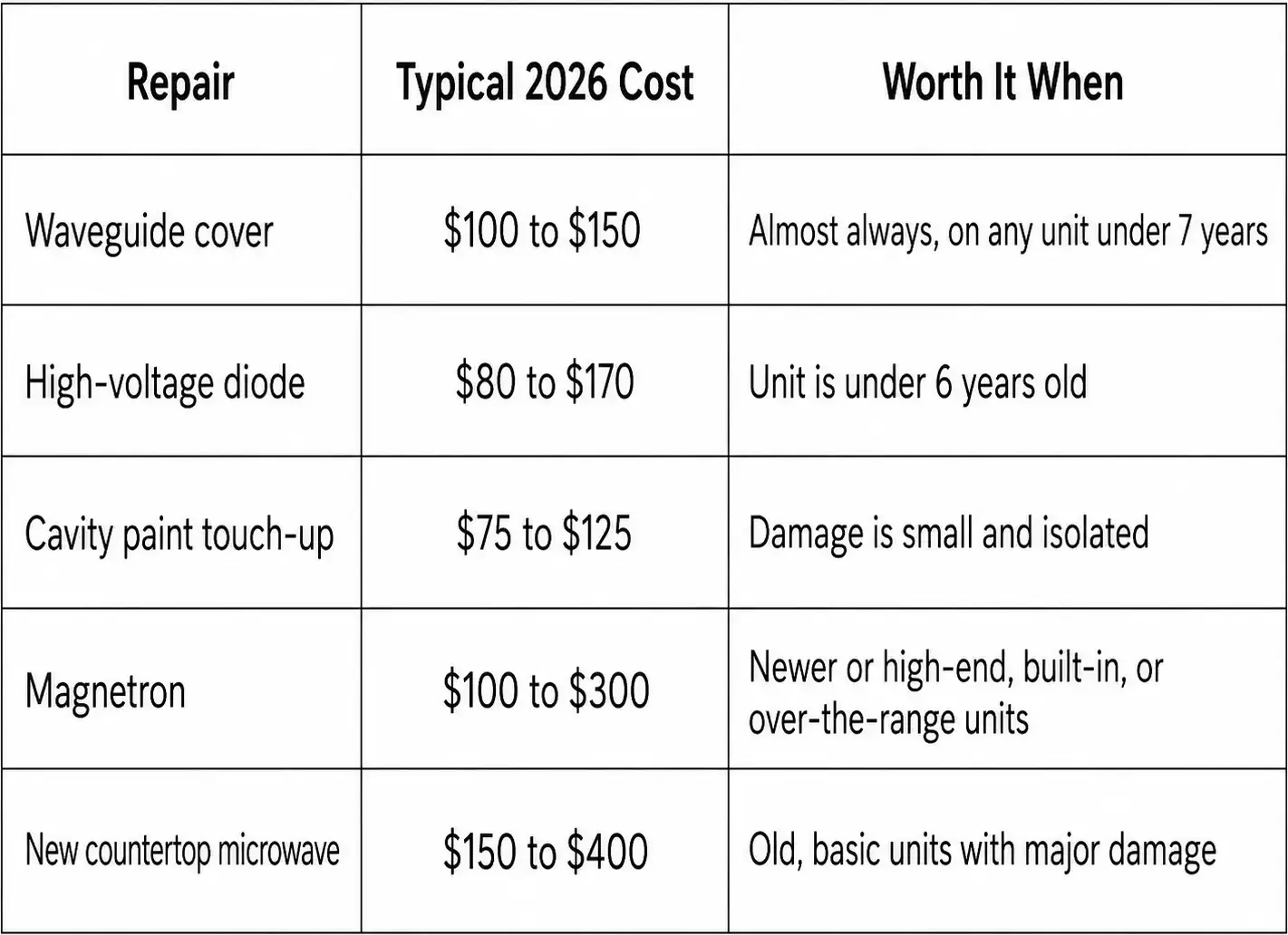
Two simple rules cut through the decision. A countertop unit past 7 or 8 years with a failing magnetron is usually not worth fixing. A built-in or over-the-range microwave almost always is, because replacement includes installation labor and cabinet fitting that dwarf the repair cost.
A homeowner in Natomas called Fair Appliance Repair Service about an over-the-range microwave that sparked in the same right-side spot every evening, even after a full deep clean. No metal, no foil, no dirty cavity. Our lead technician Sayed Sajadi found the classic signature in the first minutes of the diagnostic: a scorched, brittle waveguide cover with a pinhole burn, plus grease baked into the channel behind it.
He replaced the mica cover, cleaned the waveguide opening, and tested heating output and door seal before leaving. Total time in the home was under an hour, the repair came in at the low end of the cost table above, and the homeowner avoided replacing a built-in unit that would have cost several times more with installation. The lesson repeats across Sacramento County: sparking that returns to the same spot is a part, not a mystery.
Call a professional the moment the cause is not something you can see and remove. Here is the honest line between DIY and dangerous: anything inside the cabinet, including the diode, capacitor, and magnetron, can electrocute you. The high-voltage capacitor holds up to 5,000 volts even when the microwave has been unplugged for days. No spark is worth that risk.
Fair Appliance Repair Service handles microwave repair in Sacramento with same-day appointments across Sacramento, Natomas, Elk Grove, and Roseville. Sayed Sajadi holds California license #48671, is EPA certified, and has completed more than 4,000 appliance repairs in Sacramento County since 2020. Every visit includes a free diagnostic with repair, upfront pricing before any work starts, and a 1-year parts warranty. You can schedule same-day service online or call (916) 333-8388, and most sparking repairs are finished in a single visit because common parts ride on the van.
Do not gamble with an appliance that is already arcing. Fair Appliance Repair Service offers same-day microwave repair across Sacramento County with upfront pricing and a free diagnostic with repair.
341 Rick Heinrich Cir, Sacramento, CA 95835
📞 (916) 333-8388
Find Us On Google Maps: https://www.google.com/maps?cid=7027228233403408814
Schedule same-day microwave service or contact our Sacramento team with a photo of the burn mark, and we will tell you honestly whether it is worth fixing.
Only after you find and fix the cause. If metal caused the spark and the cavity shows no burn marks, one careful test run is fine. If it sparked with nothing metallic inside, or you see scorching or pitting, keep it unplugged until a technician inspects it.
The usual causes are a burnt waveguide cover, chipped interior paint exposing bare metal, or carbonized food residue. Mineral-rich foods like carrots and green beans can also spark on their own.
Yes. Arcs run hot enough to ignite grease and food debris, and repeated sparking near a damaged waveguide can spread damage to internal components. Treat any sparking as a fire risk and stop the cycle immediately.
Sparking plus cold food usually points to a failed high-voltage diode, sometimes a dying magnetron. Both sit next to a capacitor that stores a lethal charge, so this combination is a call-a-pro repair, not a DIY one.
Look for brown or black scorch marks, a pinhole or crack, or a soft, flaking texture on the small rectangular panel inside the cavity, usually on the right wall. Sparking that always starts at that panel confirms it.
Most sparking repairs in the Sacramento area run $80 to $170 for a diode or waveguide cover, and $100 to $300 if the magnetron is involved. Fair Appliance Repair Service quotes the exact price upfront after a diagnostic.
Yes. Dense vegetables with high mineral content can arc briefly, especially cut pieces with sharp edges. It is harmless and stops when you rearrange or cover the food.


